Release time: August 12, 2025 | Information source: Hefei Online-Hefei News
At Qingdao Underwater World this summer, the waterfall flows out a "fluorescent star river" at night. Tourists lamented that it was "so dreamy" and social media was also hotly debated. Behind this "waterfall" is the help from Hefei company Shenbi Biology. On August 21, a He News reporter walked into the company's laboratory and saw another kind of light: plants lighting up in the dark. Although luminous bacteria and luminous plants are two different technical paths, they jointly demonstrate the fresh imagination bred in the innovative soil of this city.

Light in the waterfall: Hefei technology lights up Qingdao’s night sky
In the exhibition area of Qingdao Underwater World, tourists were attracted by the 9.5-meter-high waterfall. Dots of green light in the water outline a picture of a rushing night. Many people picked up their mobile phones to take pictures and uploaded them to social platforms, and "#fluorescencewaterfall" became a hot word.
This "waterfall" is not installed with lights, but is brought by thousands of "deep sea elves" luminous bacteria. They are a bacterial colony cultivated by Shenbi Biotech through technological optimization, which can maintain stable light emission in dynamic water flow and will not be interrupted by complex environments.

“This is our first large-scale outdoor water application.” Li Renhan, founder of Shenbi Biotech, told reporters. Different from the static bottles and jars in the laboratory, the water flow of the outdoor waterfall is turbulent, and the environment is open and complex. Temperature, humidity, and light will all interfere with the luminous effect of the bacterial colonies. How to make the luminescent bacteria glow stably in such an environment was the biggest challenge the team initially faced.
R&D personnel recalled that during the early debugging stage, the light of the waterfall often flickered on and off, sometimes disappearing after half an hour. The team continued to adjust the metabolic pathways and culture methods of the luminous bacteria, and repeatedly conducted small-scale simulations until they found a process that could both ensure brightness and maintain stability.
"Being able to present it stably on the waterfall is a landmark breakthrough for us." Li Renhan said.
Compared with nature's "blue tears", this "fluorescent waterfall" is more controllable and stable. It does not need to rely on tides and climate, but relies on technologically optimized luminous bacteria to light up as scheduled every night.
Li Renhan opened a video, and on the screen, the "fluorescent waterfall" of Qingdao Underwater World slowly appeared. In the video, the crowd screamed and the camera flashed. Li Inhan paused and said: "We hope that the public will not only see a romantic scene, but also feel that this technology has truly moved from the laboratory to life."
"Its value can not only be seen in Qingdao, but it proves that bioluminescence technology can go out of the laboratory and enter real public spaces." Li Renhan said.
Plant light in the lab: A breakthrough after 532 experiments
If the waterfall shows the light of microorganisms, then in the laboratory in Hefei, the light of plants is equally surprising.
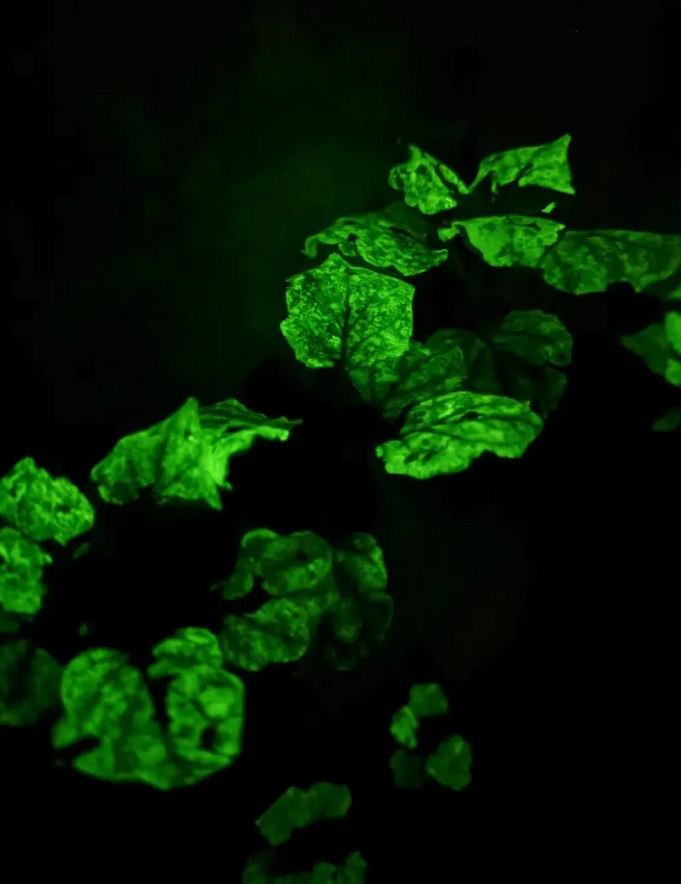
In the Shenbi Biological Exhibition Hall, several pots of seemingly ordinary tobacco plants were placed quietly. The lights were turned off, and the leaves glowed with a light green light, enough to illuminate a tabletop. "This is the first high-brightness self-luminous plant in China that we will cultivate in 2024." Li Renhan said, pointing to the plant.
This result comes from the accumulation of 532 experiments. Through gene editing, the team introduced the luminescent genes of fireflies and luminous mushrooms into plant cells, superimposed multiple genes and optimized metabolic pathways, allowing plants to independently synthesize luminescent substances.
Unlike foreign products that require camera exposure to capture low light, these plants can be seen with the naked eye in the dark. The R&D staff recalled the scene at the time: “When I saw the plant light up for the first time, everyone in the laboratory was silent for a few seconds, and then laughter and applause rang out at the same time.”
Now, the team has applied the technology to flowers such as sunflowers and petunias, and the night light of plants has moved from the laboratory to broader life scenes.
From small laboratory to industrialization: Hefei’s “accelerator”
Shenbi Bio was established in 2023. At first, there were only a few young researchers and a small laboratory. In just two years, they have built their first production line, which can produce 500,000 luminous plants every 20 days.
In the workshop, the reporter saw that the plants that had just been transferred from the cultivation room were being packed into boxes by the staff. "These will be sent to flower markets and cultural tourism projects in Beijing, Shanghai and Guangzhou, and many citizens can experience them on their balconies." a staff member said.
This growth rate is inseparable from Hefei’s innovative environment. Zhongan Chuanggu Science and Technology Park, where the company is located, is the core area of "USTSilicon Valley", providing rent-free experimental space and helping to connect with the expert resources of China University of Science and Technology and Hefei University of Technology. When experiments encounter bottlenecks, professors from scientific research institutes will be on hand to provide guidance.
"Hefei's advantage is that scientific research and industry are in the same chain, and companies can quickly find people to solve problems." Li Renhan said. For a start-up, such an "accelerator" means a lot.
Imagining the future: from glow-in-the-dark flowers to drug synthesis
Glowing plants are just the beginning. The team is trying to use gene editing in more fields, such as drug synthesis. Li Renhan gave an example: Taxol is an anti-cancer drug. It takes decades to synthesize a very small amount under natural conditions. If its synthesis pathway is integrated into plants that reproduce quickly, the cycle may be shortened to half a month.
However, in his eyes, the nearer future is to "let ordinary people see this light."
On a more daily level, luminous plants also have rich possibilities. On the balcony at night, a pot of self-luminous sunflowers can replace a night light; in urban greening, they can save some lighting electricity; in spaces such as cafes and bookstores, rows of "luminous plants" can easily create an atmosphere.
Li Inhan hopes that this kind of light will not only stay in laboratories and exhibitions, but actually enter people's lives. "
share
WeChat scan code to share
![WeChat QRCode]()

 January 13, 2026
 January 13, 2026
 January 13, 2026