Release time: August 17, 2025 | Information source: Dawan News
Recently, in front of the 9.5-meter-high cliff of Qingdao Underwater World, the water rushed down with self-cultivated luminous bacteria, forming a bright and flowing "fluorescent galaxy waterfall". The core technical support for this landscape comes from the "Deep Sea Elf" luminous bacteria cultivation technology provided by Hefei Shenbi Biotechnology Co., Ltd. (hereinafter referred to as Shenbi Biotechnology) - the company applies self-developed, biotechnology-optimized luminous bacteria to large dynamic waterscapes, achieving stable operation in a complex open environment.

It is reported that Shenbi Biotechnology successfully developed China's first high-brightness self-luminous plant at night in 2024, filling the technological gap at home and abroad. At present, the company has mastered the large-scale, low-cost and stable production process of luminous bacteria, marking a major breakthrough in the field of biosynthesis technology in my country.
Technology Breakthrough: 532 iterations culminate in fruitful results
Walking into the exhibition hall of Hefei Shenbi Biotechnology Co., Ltd., several pots of "safflower tobacco" were neatly displayed on the display racks. With green leaves and small appearance, they look ordinary. Once the indoor lights are turned off, their unique "self-luminous" properties will immediately appear - the "green light" of 3 to 4 potted plants is as bright as an ordinary night light. This is exactly the gene-edited high-brightness night-time self-luminous plant created by the company's R&D team through gene editing technology in 2024.
"The team started research on luminous plants in 2023 and after 532 experiments, finally broke through the foreign technology monopoly in 2024 and developed the first gene-edited high-brightness self-luminous plant in the country." Li Renhan, the company's chairman, said that the team used gene editing technology to introduce the luminescent genes of fireflies, luminous mushrooms and other organisms into plant cells, so that they can emit high-brightness light visible to the naked eye at night, replicating the magical luminous plant scene in the movie "Avatar". At the same time, the team optimized the reaction enzyme efficiency, superimposed multiple genes, modified plant restriction genes, and successfully integrated and modified more than 20 endogenous and heterologous genes, ultimately giving birth to the first plant in China that can autonomously glow in the dark.
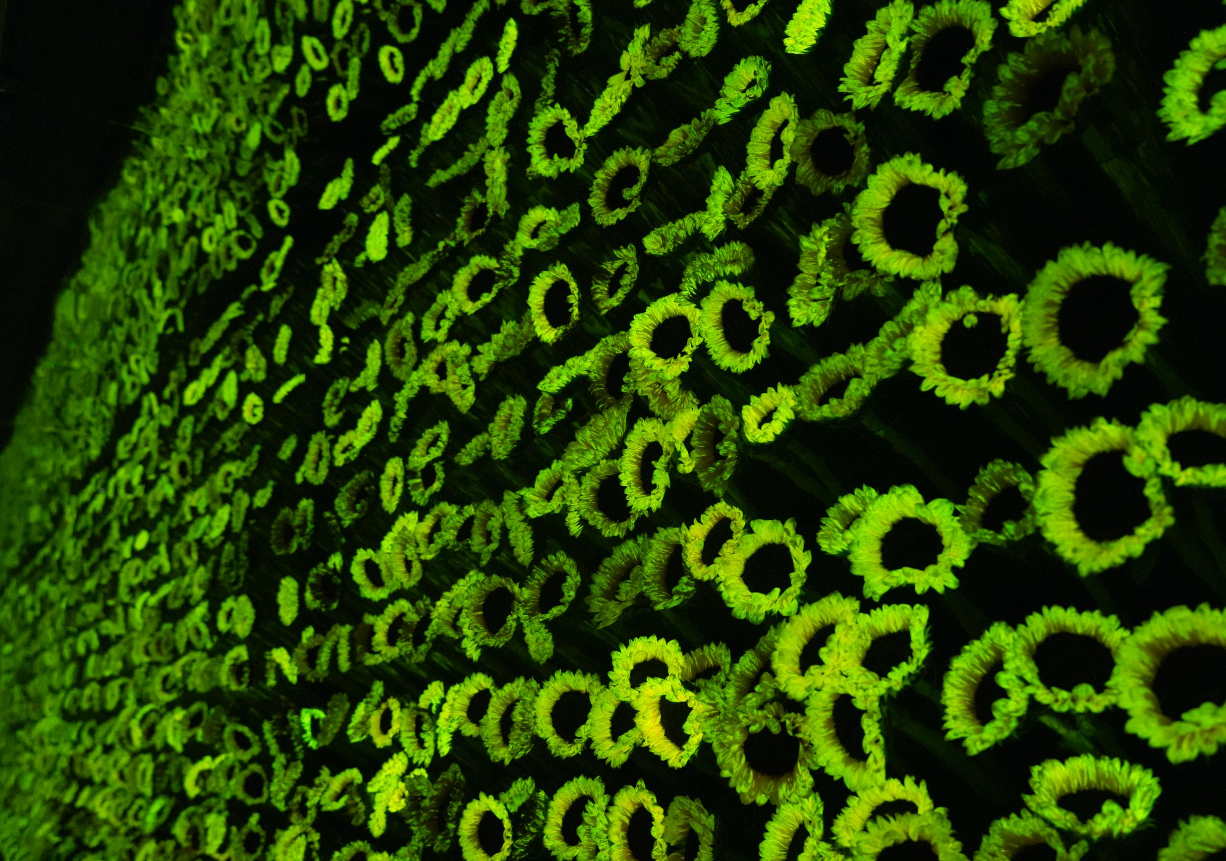
Unlike similar foreign products that require long-term exposure with high-sensitivity cameras to capture low light, the brightness of Shenbi Bio's self-luminous plants far exceeds international standards and can shine in the dark without any exposure assistance.
"We are not simply transplanting luminescent genes, but using biosynthetic technology to allow plants to form a complete luminescent metabolic pathway." Li Renhan explained that the team integrated the key characteristics of natural luminescent organisms into target plants, allowing them to independently synthesize luminescent substances, solving the problem of traditional fluorescent plants' unstable luminescence and dependence on external conditions.
At present, this technology has been applied to flowers such as sunflowers and petunias, and the team is also conducting research and development on more plant varieties.
Industrial transformation: from laboratory to mass market
Since its establishment in 2023, Shenbi Bio's development trajectory has been as dazzling as its luminous plants: it was selected for the "HKUST Silicon Valley Key Industrial Chain Project Award" just three months after its establishment; in December 2023, it received tens of millions of financing from Meihua Venture Capital, injecting impetus into research and development.
2024 has become a key year for technological breakthroughs: in July, the first self-luminous plant "Bunta japonica" was successfully developed; in August, CCTV conducted a special report on the technology; in November, the iterative product "Glowing Sunflower" was launched; in December, the luminous sunflower was commercialized.
Production capacity construction is being promoted simultaneously: the new production line to be built in 2024 will achieve the large-scale mass production capacity of "producing 500,000 plants every 20 days".
In 2025, the company's pace of innovation will continue to accelerate. In July, it cooperated with the Beijing National Museum of Nature and Qingdao Underwater World to jointly hold the world's first self-luminous plant themed exhibition at night; recently, at the "I Dare, I Will Create" 2025 China International University Student Innovation University, jointly organized by the Beijing Municipal Education Commission and Beijing University of Posts and Telecommunications, In the selection of the Beijing competition, a graduate entrepreneurial team guided by Dr. Li Renhan, founder of Shenbi Biotechnology, won the first prize for its project "Star Firefly Night Flower-the country's first self-luminous plant technology application at night". This award is a high recognition of the project's technological innovation and application exploration results.
Application scenarios: lighting up a green future in many fields
Standing in front of the "Fluorescent Galaxy Waterfall" at Qingdao Underwater World, the audience was shocked by a dreamy scene: on an outdoor cliff 9.5 meters high and more than 10 meters wide, luminous bacteria poured down with the water, outlining a bright flowing green galaxy; the "bubble column" device in the indoor exhibition area allowed visitors to wake up the glow of the bacteria through a touch switch, bringing a wonderful interactive experience. This marks an important breakthrough for Shenbi Bio's bioluminescence technology from the laboratory to public experience, and has also become a successful example of the application of Shenbi Biotechnology.

It is understood that thanks to the large-scale, low-cost and stable production process of luminous bacteria that has been mastered, these diverse application scenarios can be stably presented, laying a technical and cost foundation for the implementation of more cultural and tourism creative projects in the future.
For future applications, the team has rich ideas: in the home scene, it can be used as a "plant pet" for balcony decoration or bedside night light; in the municipal greening field, it can replace part of the lighting project to save energy; in the cultural and tourism industry, large-scale planting can be used to create a magical landscape like "Avatar".
Fertile soil for innovation: ecological empowerment of Hefei High-tech Zone
The rapid development of Shenbi Biology is inseparable from the nourishment of Hefei High-tech Zone, a fertile ground for innovation. The Zhongan Innovation Valley Science and Technology Park where the company is located is located in the core industrial area of "HKUST Silicon Valley" and is positioned as an international science and technology innovation community.
In January this year, all 13 units of the Zhongan Chuanggu Digital Science Park project were capped. The project is centered on emerging industries such as artificial intelligence, electronic information, big health, and aerospace information, and can accommodate 7,000 people for innovation and entrepreneurship in the future.
“I chose to take root in Hefei High-tech Zone because of its fertile ground for innovation.” Li Renhan said frankly that synthetic biology research requires interdisciplinary collaboration and high-end equipment support, and the High-tech Zone not only provides rent-free experimental space, but also connects the expert resources of the University of Science and Technology of China and Hefei University of Technology through “government platforms”. This "professional incubation + precise service" model helped the team break through the core technology in just one year and build the world's first plant bioluminescence system with completely independent intellectual property rights.
It is reported that as an important node of the Yangtze River Delta G60 Science and Technology Innovation Corridor, Hefei High-tech Zone has gathered more than 700 biopharmaceutical companies, accounting for 60% of the city's industry share. More than 50 pharmaceutical innovation platforms gather in the zone to provide a full range of technical services.
In addition, in order to continuously improve the professional market-oriented operation level of science and technology parks, connect the entire chain of achievement transformation, entrepreneurial incubation and industrialization, and cultivate more high-growth enterprises, the "policy guidance + platform support + full-chain services" ecosystem established by Hefei High-tech Zone has become an accelerator for enterprise growth.
Light of the future: from plant factory to global market
With the core technology of gene editing in hand, Shenbi Biotech’s future plans are clear and ambitious. "The current output and sales have stabilized, but product iteration cannot stop for a moment." Li Renhan said that in addition to luminescence properties, the team is exploring more possibilities of gene editing technology - through a unique cell expression platform, allowing plants to synthesize pure natural high value-added substances.
"For example, it takes decades to synthesize 1 mg of paclitaxel in yew trees. By integrating the synthesis pathway into plants that reproduce quickly, it can be shortened to 15 to 20 days to synthesize a batch." Li Renhan said that this breakthrough will bring revolutionary changes to drug production.
In terms of industrialization, the company has formed three major product lines: "urban landscape - ecological scene - home gardening", marking the entry of bioluminescence technology into the stage of large-scale application. In addition, the construction of municipal night scene greening and luminous plant theme parks has been included in the development blueprint. With the successful implementation of cultural tourism projects with Beijing and Qingdao in 2025, more cities have extended an olive branch to this innovative enterprise for cooperation.
"We will continue to deepen the research on bioluminescence technology and expand its application value in landscaping, ecological indication and other fields." Li Renhan said.
From self-luminous plants that can replace night lights to the "fluorescent galaxy waterfall" flowing on the 9.5-meter cliff of Qingdao Underwater World, Shenbi Biotech uses gene editing technology to break through foreign monopolies in the field of bioluminescence, allowing "Chinese light" to continue to shine in laboratories and application scenarios.
When technological innovation meets the beauty of nature, dreamy plants that once only existed in the "Avatar" movie are being turned into reality by Chinese innovative enterprises, lighting up a green future where humans and nature coexist harmoniously.
share
WeChat scan code to share
![WeChat QRCode]()

 January 13, 2026
 January 13, 2026
 January 13, 2026