Release time: August 17, 2024 | Information source: synbio deep wave
Synthetic biologists are using genetic engineering technology to make luminous plants a reality and begin to enter our lives.
In February this year, the American synthetic biology company Light Bio announced that the company's gene-edited "Glowing Petunia" has been approved by the U.S. Department of Agriculture and is sold in the 48 contiguous U.S. states (except Alaska and Hawaii) at a price of $29 per plant and $24 for shipping. As of the end of April, its first batch of 50,000 plants had been sold out.
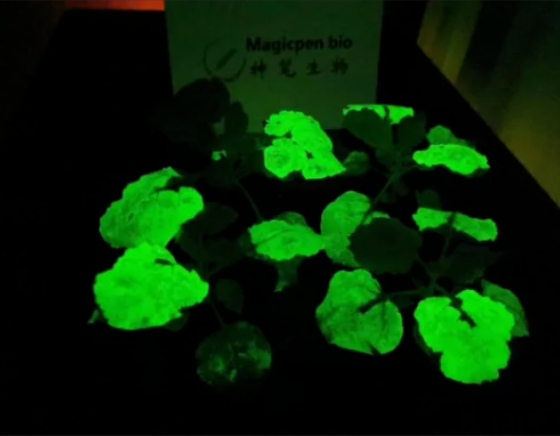
Recently, the R&D team of Hefei Shenbi Biotechnology Co., Ltd. announced that it has developed the first gene-edited high-brightness self-luminous plant in the country.
Research on bioluminescent plants can be traced back to 1986, when Keith Wood transferred the firefly luciferase gene into tobacco, allowing it to emit firefly-like light. Since then, other companies have also been researching luminous plants. However, the light emitted by this enzyme is limited, and its luminescence must be combined with the substrate luciferin to be excited, which limits its application.
Until 2018, synthetic biologist Karen Sarkisyan of the Institute of Medical Sciences in London and molecular biologist Ilia Yampolsky of the Russian Academy of Sciences analyzed the luminescence principle of naturally occurring luminous mushrooms, and the three hit it off and founded Light Bio.
The luciferase of this glowing mushroom uses caffeic acid as a luminescent substrate, and land plants can also produce caffeic acid. This means that if the luminescent mushroom's luminescent system is transferred to other plants, it can emit light on its own without providing an additional luminescent substrate.
Shenbi Bio's scientific research team has gone through 532 technical iterations, optimizing the enzymes in the reaction process, improving enzyme efficiency, superimposing multiple genes at the same time, changing some of the plant's own restriction genes, and achieving high-throughput expression of foreign genes in plant cells, allowing plants to reach a high-brightness state visible to the naked eye, with brightness far exceeding existing international standards.
At present, Shenbi Biology has successfully achieved high-brightness self-luminescence on a variety of plants, including sunflowers, and is expanding its luminescence technology for other flower species. "We are transforming roses, roses, lilies and other flowers. We hope to see a variety of luminous plants appear on the market in the future," Li Renhan said.
"This technology has broad application prospects and may change the nighttime landscape of future cities." Li Renhan, head of the Shenbi Biological Research Team, said that luminous plants can be used in home decoration, children's night lights, and even park greening and municipal road greening.
share
WeChat scan code to share
![WeChat QRCode]()

 January 13, 2026
 January 13, 2026
 January 13, 2026